

Closing the Gap and Women Leading Digital Transformation in Tech
Updated: 22 minutes ago
Anham Shaheen is a Dubai-based technology entrepreneur and digital strategist specializing in scalable digital systems, AI, automation, and business transformation. As the founder of PixelWave and a certified Project Manager, she combines technology, strategy, and structured execution to drive measurable business growth.

Here is the bitter truth you probably don't want to accept: You might be part of the problem, even if you believe you support women in technology. Before you disagree, ask yourself something. When a woman walks into a room full of technology professionals, do you automatically assume she knows what she's talking about? Or do you wait for her to prove herself first?
Now imagine a man walking into that same room, with the same qualifications, experience, and knowledge. Would you question him in the same way?
If your answers are different, perhaps this article is exactly what you need to read. I am not writing this to attack men, praise women, or start another argument about which gender is better. Frankly, I think we have spent enough time doing that.
I am writing this because technology is supposed to represent progress. Yet sometimes, the people building the future are still carrying assumptions from the past.
That is something worth talking about.
Why are women still underestimated in technology?
Throughout my journey in technology and business, I have encountered situations where being a woman, and particularly a young woman, has influenced how people perceive my capabilities.
It is not always something somebody says directly. Sometimes it is simply the atmosphere in the room.
You can explain a technical problem, propose a solution, or make a recommendation, and still sense that people are waiting for somebody else to confirm whether you know what you are talking about.
Sometimes that somebody else is not even a person. It is ChatGPT. I have seen situations where people would rather ask AI a technical question than consider the explanation already being provided by a woman sitting right in front of them.
Now, I have nothing against ChatGPT. I work in technology, and I understand the value of AI tools.
But here is where it gets funny. When I explain something in simple English, my knowledge can be questioned. When ChatGPT explains the same concept using complicated technical terminology, suddenly the explanation carries more authority.
When nobody understands what ChatGPT is saying? Guess who gets asked to explain it. The woman who apparently did not know enough five minutes ago.
Congratulations. You have now promoted her to technical translator. But women in technology are capable of much more than translating technical terminology for other people.
They can identify problems, design solutions, manage development teams, make strategic decisions, and lead technology projects.
The question is not whether women are capable of doing these things. The question is whether they are being trusted with the opportunity to demonstrate that capability.
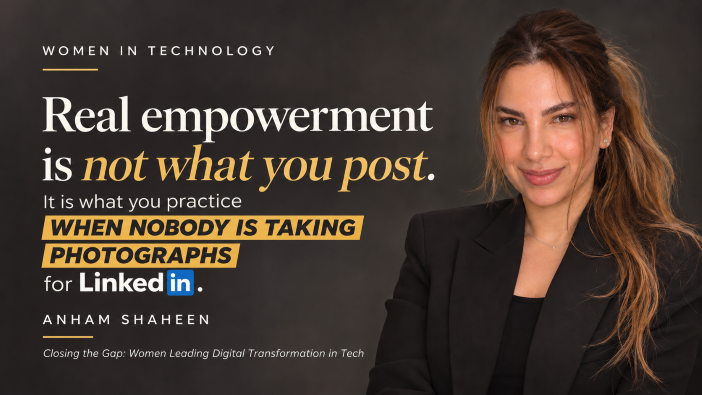
Is women's empowerment becoming a performance?
Every year, International Women's Day arrives, and suddenly everybody has something beautiful to say about women.
Companies publish inspiring messages. Executives deliver speeches. Social media fills with photographs, appreciation posts, and statements about equality.
I think recognizing women's achievements is important. But recognition and empowerment are not the same thing.
Let me give you an example. Imagine somebody standing on a stage, delivering a passionate speech about protecting the environment, saving endangered species, and reducing pollution.
The audience applauds. Everybody feels inspired. Then the speaker finishes the speech, boards a private jet, and continues with the day. Now, the speech might have been wonderful. But what happened to the actual commitment?
That is how I sometimes feel when I see organizations celebrating women's empowerment without giving women meaningful authority in their everyday operations.
You cannot celebrate a woman's intelligence on Monday and question her competence simply because she is a woman on Tuesday. You cannot talk about female leadership publicly while privately refusing to trust women with important decisions.
You certainly cannot call something empowerment when the woman being celebrated has no real opportunity to influence what happens.
To be fair, I have also seen encouraging progress.
Living and working in Dubai, I have observed increasing openness toward women in leadership and decision-making positions. That progress matters, and it deserves recognition. But progress does not mean that every outdated assumption has disappeared.
There is still work to do.
What happens when sexism meets ageism?
Being a woman in technology is one thing. Being a young woman in technology can introduce another challenge entirely.
At the beginning of my professional journey, I encountered people who questioned not only my gender but also my age. Sometimes the attitude felt like this, "Oh, she was just born yesterday. Why is she ahead of me?"
Apparently, some people believe knowledge arrives automatically with birthdays. Unfortunately, that is not how skills work.
You can be 40 years old and have less knowledge of a particular technology than somebody who is 20. You can be 20 years old and still have plenty to learn from somebody who is 40.
A man can be more skilled than a woman in a particular field. A woman can be more skilled than a man in that same field.
None of these statements should be controversial. Yet people sometimes struggle to accept that somebody younger, somebody different, or somebody they did not expect might know more than they do.
Why? I believe part of the problem is that people sometimes treat another person's intelligence as a threat to their own position.
Instead of thinking, "This person knows something I don't. Maybe I can learn from them," they begin worrying about what that person's knowledge means for their own authority.
That mindset creates unnecessary competition, information gatekeeping, and missed opportunities for collaboration.
It does not benefit the business either. Technology evolves too quickly for anybody to believe they know everything. The smartest person in the room should not be the person who refuses to learn from others.
It should be the person who understands that there is always something more to learn.
Are we judging skills or appearances?
There is another uncomfortable subject we need to address.
Women in professional environments can sometimes be judged by their appearance before their abilities are taken seriously.
In my experience, this can be particularly frustrating in technical settings, where the quality of someone's thinking should matter far more than how they look.
A woman should not have to choose between being recognized for her intelligence and being seen as a woman.
Those two things are not mutually exclusive. This is not about claiming that every man behaves inappropriately or that every workplace has the same problem.
It is about acknowledging that these attitudes exist, even when they are subtle. Sometimes the bias appears in who gets interrupted during meetings. Sometimes it appears in whose recommendation is questioned.
Sometimes it appears in who receives the responsibility to lead a technical project and who is expected merely to assist.
The solution is not to assume every woman is automatically qualified. That would defeat the entire purpose. The solution is to evaluate people fairly.
Ask whether they understand the technology. Whether they can solve the problem. Whether they can communicate clearly. Whether they can manage the responsibility.
Those questions tell you something useful. Their gender does not answer any of them.
What should young women entering technology understand?
If I were speaking to a young woman beginning her career in technology, the first thing I would tell her is simple.
Stand your ground. Expect that somebody might try to put you down, but remember that you do not have to stay down.
You cannot control every opinion people have about you. You cannot control whether somebody feels threatened by your ambition, questions your age, or underestimates your intelligence. But you can control how you respond, how you develop your skills, and what you choose to do next.
No, I do not believe the answer is to fight everybody who disagrees with you. That would be exhausting. Sometimes you need to play your cards right.
Not every comment deserves an argument. Not every disagreement is an attack. Not every person who doubts you needs to become your enemy.
Learn to recognize the difference between constructive criticism and prejudice. One can help you improve. The other should not be allowed to define you.
Turn emotional awareness into professional strength
I also believe that qualities sometimes dismissed as weaknesses can become strengths when used intelligently.
Emotional awareness, empathy, the ability to understand different personalities, and managing several responsibilities can all be valuable in technology leadership. Of course, these abilities are not exclusive to women. They are skills that people can develop.
But women should not feel that they must abandon these qualities to be taken seriously in technical environments. Technology projects involve more than code. They involve people, communication, deadlines, disagreements, expectations, and decisions.
Understanding people can be just as important as understanding the systems they are building. The key is learning how to use your emotions wisely rather than allowing every difficult situation to control your response.
Build competence before demanding recognition
Confidence matters, but confidence without knowledge will only take you so far.
If you want to lead a technical project, understand the project. If you want to challenge a developer's recommendation, understand why you are challenging it. If you want people to trust your decisions, make sure those decisions are supported by knowledge, reasoning, and accountability.
Keep learning. Ask questions. Build your technical understanding. Work with people who know more than you. Never confuse asking for help with being incapable.
The purpose is not to prove that you know everything. It is to become somebody who can contribute meaningfully, recognize what they do not know, and continue improving.
Find an opportunity inside the difficulty
One principle I try to apply is that a weakness or negative situation can sometimes become an opportunity.
If somebody underestimates your knowledge, use the situation to strengthen how you communicate it. If you are inexperienced, learn from people who have already made the mistakes you want to avoid.
If somebody challenges your decision, examine whether the challenge reveals something useful. Not every negative experience will have a positive explanation, and discrimination should never be excused as a learning opportunity.
But you can still decide what you take away from an experience. Sometimes the most valuable response is not winning an argument.
It is becoming better at what you do.
Why should men and women work together rather than compete?
I want to make something very clear.
My vision for women in technology is not an industry where women replace men. I do not want men to feel that empowering women means taking opportunities away from them. I do not believe we should measure progress simply by deciding which gender should outnumber the other.
That is not equality. That is just another competition.
Men and women can bring different experiences, perspectives, personalities, and strengths into a team. Those differences vary from person to person, and they can complement one another.
What matters is whether we know how to work together. If somebody is more knowledgeable than you, why should that automatically threaten you? Why not learn from them? If somebody has a skill you do not possess, why not combine your abilities to produce something better?
I have never understood the idea that helping somebody else grow must somehow reduce your own value.
In technology, especially, collaboration is essential. A successful digital transformation project can involve developers, project managers, designers, cybersecurity specialists, business strategists, and operational teams.
Nobody succeeds simply because of a job title, gender, or age. They succeed because people contribute their abilities toward a common objective.
The goal should not be to prove that women are better than men or that men are better than women. The goal should be to build teams where capable people are allowed to be capable.
What does genuine equality in technology look like?
For me, equality is not complicated.
If a man can become a Chief Technology Officer, a qualified woman should have the same opportunity. If a man can lead a software development project, a qualified woman should have the same opportunity.
If a man can make strategic decisions about AI, cybersecurity, or digital transformation, a qualified woman should have the same opportunity. The same standard must work in both directions.
Nobody should receive a position simply because of their gender. Nobody should be denied one because of it either.
That is the equilibrium I would like to see in technology. Not a world where men and women constantly compete to prove who deserves more.
A world where they can work hand in hand, respect each other's capabilities, and recognize that the success of one person does not automatically mean the failure of another.
For businesses, that means examining who gets trusted with responsibility, whose ideas are heard, who receives mentorship, and whether opportunities are being distributed based on actual capability.
For leaders, it means recognizing their own assumptions before those assumptions become somebody else's professional limitation.
For women entering the industry, it means continuing to build their knowledge and confidence without allowing somebody else's prejudice to determine their ambitions.
The future of technology needs talent, not prejudice
We talk constantly about artificial intelligence, automation, innovation, and the future of work. We invest in smarter systems, faster software, and increasingly sophisticated technologies. Yet sometimes, we still struggle with something as basic as recognizing intelligence in another human being.
Perhaps that is the irony of our industry. We are teaching machines to become smarter while some of us are still learning how to appreciate the intelligence sitting across the meeting table.
So the next time a woman explains a technical problem, listen to what she is saying before deciding whether she knows enough. The next time a younger colleague presents an idea, consider its merit before questioning their age.
The next time your organization celebrates women's empowerment, ask whether those same women are genuinely trusted with decisions when the celebration is over.
Because the future of technology does not need a battle between men and women. It needs people who are intelligent enough to recognize the value in one another.
Technology has no gender. Skills have no gender. Opportunity should have no gender either.
Perhaps the day we stop being surprised by a capable woman in technology is the day we can finally say we have made real progress.
Read more from Anham Shaheen
Anham Shaheen, Technology Entrepreneur & Digital Strategist
Anham Shaheen is a Dubai-based technology entrepreneur and digital strategist focused on transforming complex business challenges into structured, scalable digital solutions. She is the founder of PixelWave, where she works across digital strategy, technology, AI, automation, and performance-driven systems designed to improve efficiency and support measurable growth. A certified Project Manager, Anham brings a structured approach to connecting business strategy with practical technology implementation. Her work reflects a broader commitment to advancing technology-driven entrepreneurship in the region and encouraging greater female representation in technology and leadership.







