

Building Trust in the Future of Global Agriculture – Exclusive Interview with Amanda Muessli
Amanda Müessli is an international entrepreneur and business strategist with over a decade of experience in agriculture and medical cannabis. As Founder and CEO of Green Tech Global, she works with governments, investors, and private enterprises to develop cultivation, processing, and export-focused projects worldwide. Her expertise spans cultivation infrastructure, regulatory compliance, operational strategy, and international market development. Amanda is passionate about advancing sustainable agriculture, innovation, and emerging industries across global markets.
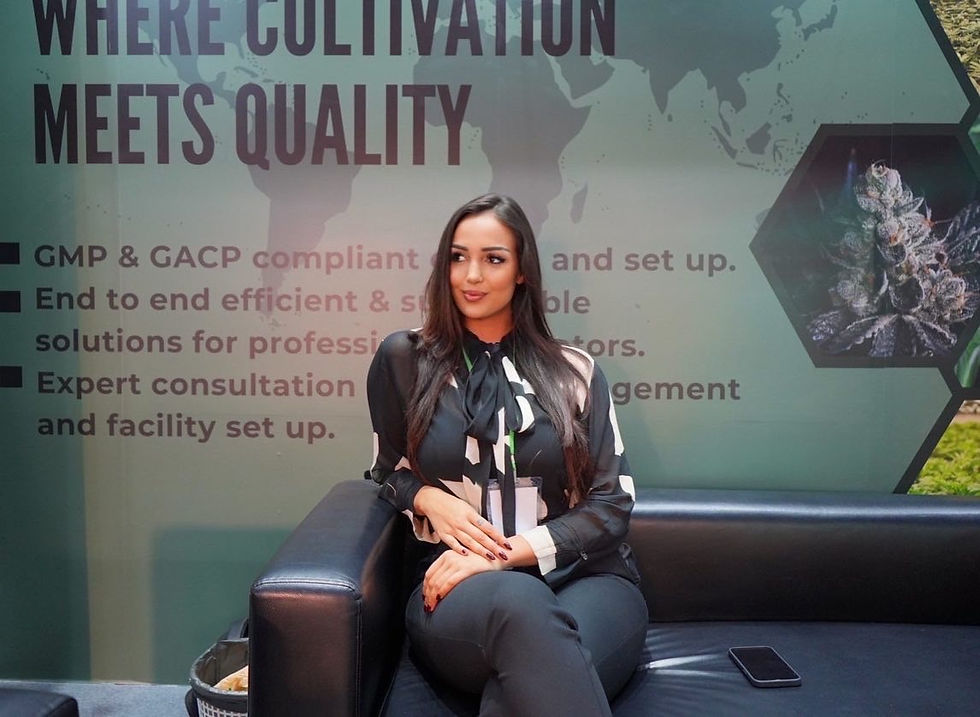
Amanda Muessli, Founder and CEO of Green Tech Global
What first drew you to building businesses in agriculture and highly regulated industries?
My entry into this industry wasn’t planned, it emerged from a real result. While I was still studying to become a nurse in Switzerland, my father, an inventor, developed specialized LED technology that he tested with a local cannabis farm that had been operating for 15 years. The farm achieved its highest yield in that entire 15-year history using his LEDs. That result told me something important, there was still significant room for innovation in an industry many assumed was already optimized. I stepped in to bring his LEDs to market, then built a company subcontracting the additional suppliers needed to deliver complete, functioning farms rather than isolated components. From there, I immersed myself in the operational realities of the industry, working alongside established leaders, studying which farm structures succeeded long-term and which failed, and refining that knowledge continuously. As we expanded into vertical farming, that expertise led to consulting engagements with government and private farms across Africa and Asia, conducting feasibility studies and advising on optimal structures for specific crops, ultimately helping establish farms internationally.
After working on agricultural and medical cannabis projects across multiple continents, what separates the projects that succeed from those that struggle?
The projects that succeed treat regulation as the foundation, not an obstacle to work around. A pattern I see constantly is companies eager to export without understanding that export readiness comes with real structural and compliance requirements, proper standards, SOPs, licensing, and the budget needed to support all of it. Many underestimate this cost, especially when they haven’t raised sufficient funding to begin with. The projects that struggle are usually the ones unwilling to invest the time and resources into proper compliance work, and they tend to fail for exactly that reason. Success requires early, deep engagement with regulatory frameworks and local stakeholders from the start. It also takes genuine credibility with operators, ministries, and partners on the ground, something capital alone can’t buy. That kind of trust takes patience and sustained presence, not a quick capital injection.
What have governments and investors misunderstood most about building sustainable agricultural industries?
I wouldn’t say it’s universal. I’ve worked with governments across Africa, Asia, and the MENA region that understand this deeply and have built genuinely strong agricultural strategies. But where I do see room for improvement, it often comes down to who’s advising them. I’ve seen large companies raise several hundred million for a setup that could realistically have cost half that, simply because they worked with the wrong consultants. It’s not about bad intentions at all, it just shows how much the right technical and regulatory guidance can shape the cost efficiency of a sustainable farming project. I’d also gently encourage teams to learn export requirements and SOPs early on, rather than treating them as a later step. Getting the right advice from the start, on both build costs and compliance, tends to be the difference between a project that scales smoothly and one that ends up spending more than it needs to.
Why do you believe the future of agriculture depends as much on trade infrastructure as it does on cultivation technology?
You can grow the best product in the world, but if there’s no trusted, compliant way to move it to market, that value never gets realized. I’ve watched this play out repeatedly across the farms and ministries I’ve worked with, the constraint isn’t yield, it’s trust between buyer and seller across borders, verified compliance, and secure payment. That’s what led me to build FieldLink, a marketplace focused on solving the trade infrastructure problem rather than the production problem. You can have the most advanced cultivation technology in the world, but without the trade infrastructure to move it, none of that innovation actually reaches the people who need it.
What challenges in global agricultural trade inspired you to create FieldLink?
After more than a decade running Green Tech Global, I kept encountering the same problem from different angles, legitimate buyers and sellers across MENA, Africa, and Asia who genuinely had supply and demand that matched, but who simply couldn’t get to a transaction because there was no trusted way to bridge the gap. Compliance standards varied wildly from one market to another, payment was risky on both sides, and verifying a supplier or buyer meant relying entirely on personal relationships and word of mouth. That works at a small scale, but it doesn’t scale, and it leaves enormous amounts of legitimate trade simply not happening because nobody wants to take on the risk. I saw this repeatedly, deals that made complete commercial sense falling apart not because of price or quality, but because of trust. FieldLink came out of that frustration. It’s the infrastructure I wished had existed throughout my own career in this space.
For entrepreneurs entering regulated industries, where should they focus their attention before thinking about growth?
I’d say start by genuinely understanding the people you’re working with, not just the regulations. Every regulated industry has its own ecosystem of decision makers, government bodies, local operators, compliance authorities, and that ecosystem operates on relationships built over time, not transactions. Early on, I’d encourage entrepreneurs to spend real time on the ground, learning how things actually get done in that specific market, which is often quite different from how it looks on paper. Pair that with a genuine respect for the compliance process itself, since it usually exists for good reason, even when it feels slow. Once you have that foundation, the relationships and the credibility, growth tends to follow much more naturally because the right doors open for you. Without it, even a great product can struggle to gain traction. I built my own network this way over more than a decade, and it’s been worth far more than any shortcut would have been.
What practical steps can agricultural producers take to become more competitive in international markets?
Start with documentation and compliance readiness before you start chasing buyers. International buyers move quickly when trust is already established, and slowly, or not at all, when it isn’t. Beyond that, producers should focus on consistent data collection on their operations, yield, input usage, and quality metrics, since this is what allows them to prove reliability rather than just claim it. Quality control needs to be built into the process from the start, not inspected for at the end. I’d also encourage producers to look closely at sustainable growing methods, not only for environmental reasons, but because they often meaningfully reduce operational costs over time, which directly improves competitiveness on price. Finally, international competitiveness isn’t only about price or quality individually, it’s about reliability and transparency over time. Buyers return to producers they trust to deliver consistently within a compliant framework.
How has your definition of leadership evolved as you’ve moved from building companies to helping build entire industry ecosystems?
Early on, leadership meant making good decisions for my own company, getting the product right, the team right, the numbers right. Years of working across agriculture and medical cannabis taught me how much individual businesses depend on the wider ecosystem around them, the standards, the relationships, the trust between players. That shaped how I approached FieldLink. Rather than just building a platform for my own use case, I tried to build something that could genuinely make trade easier and more trustworthy for the people using it, buyers and sellers, whom I’ll never personally meet. It’s a different kind of responsibility than running one company. It means thinking less about what’s best for a single deal in front of me, and more about whether the system as a whole is fair, reliable, and worth trusting. I don’t see it as changing an industry single-handedly, more as contributing something useful that others can build on too.
If you could leave business leaders with one lesson about innovation, sustainability, and long-term impact, what would it be?
To me, being a leader means leaving something behind that makes things a little easier for people, even if it only changes one or two lives for the better. It’s not about scale for the sake of scale. Innovation and sustainability only really matter if they make people’s lives easier and help the ecosystem around them run more smoothly, because at the end of the day, that’s what pays people, literally and otherwise. I’d rather build something that quietly improves how a few people work and live than chase something impressive that doesn’t actually help anyone. If business leaders kept that closer to the center of every decision, whether you genuinely made something easier or better for the people depending on you, I think a lot of innovation would hold up a lot longer than it currently does.
Read more from Amanda Muessli







