

5 Common Authenticity Myths That Block Your Most Authentic Life
Written by: Sabrina Sourjah, Executive Contributor
Executive Contributors at Brainz Magazine are handpicked and invited to contribute because of their knowledge and valuable insight within their area of expertise.

It’s really hard to admit that you have been living an inauthentic life. But in my case, this is true, and I have finally accepted it as such.

Photo by Kyle Sudu on Unsplash
As a certified authenticity coach, who wants to get as close as possible to my authentic life and help my clients access their authentic lives, it would only be right for me to admit where I was with no regrets about my past.
I used to work in a field that didn’t excite me, although it was the future, and I felt like I was supposed to get excited by it. Although freedom is one of my most important values, I stayed in stringent corporate corridors, following processes and procedures that made no sense to me.
I was in a marriage I felt I was supposed to be in forever because we got married amidst many obstructions and societal conventions due to our religious and racial differences.
When it came to my friendships, most of them were based on proximity, familiarity, and shared hobbies. Our value systems were very different, and I didn’t point out when I disagreed with them because I was people-pleasing big time.
So, I was definitely living an inauthentic life for a long time.
Define authenticity
Authenticity is one of those buzzwords in today’s world. We throw it around with or without weight and take it for granted that everyone knows what the word means.
Let’s start with a good old dictionary to get our bearings.
According to Oxford Languages,
adjective: authentic
of undisputed origin; genuine.
(in existentialist philosophy) relating to or denoting an emotionally appropriate, significant, purposive, and responsible mode of human life.
In my humble opinion, none of these definitions fully encapsulate the complexity of authenticity in connection to human life. Let me convince you why by exploring the five myths I’ve observed often.
1. “I have never been inauthentic. Why would I ever be?”
For most of us, being inauthentic is synonymous with being ingenuine or fake, as the Oxford Languages point out. So, we don’t want to admit that we have been inauthentic at times.
We need to break away from this interpretation of an inauthentic life. I believe we have all been inauthentic at times, not with the malicious intent of misleading someone, but because it is our human nature to be inauthentic sometimes
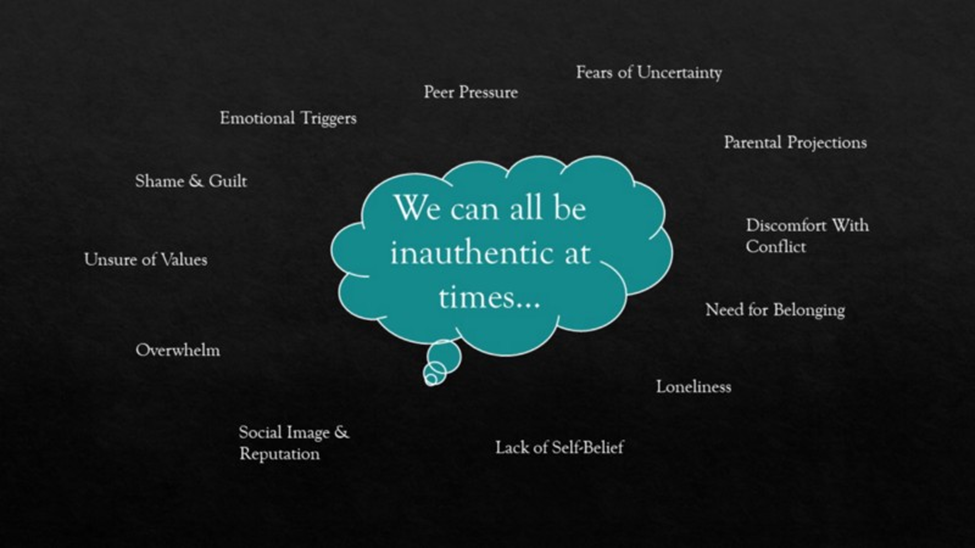
When can we be inauthentic? (Source: Author’s Workshop on Authenticity)
We are born with very little mindset programming, and we absorb everything from the world starting from childhood. Experts state that ages 2–7 are significant for brain development. When we take in so much from the world, and our caregivers and given that we long for societal belonging, isn’t it natural that we pick up ideas and values that may not resonate with us?
My simple definition of authenticity is,
Living life in alignment with our values and purpose.
So, we can be inauthentic when we are not living in alignment with our values or operating from our highest selves and purpose. If you want to know more about how to find out what your values are, you can check out this article on deepening a dating conversation using values.
Let me give you a few examples of when I have been less than authentic.
When I have been driven by fear and not my highest self, e.g., I stayed in a 9 to 5 job for a decade because I was scared of the uncertainty of entrepreneurial life.
When I was worried about what people would say, e.g., I remained married for much longer because I thought about all the people who had warned me against interracial marriage.
As a child, I picked up beliefs that had nothing to do with me, e.g., I recently realized that I was unnecessarily trying to save money because of a poverty mindset I picked up from one of my primary caregivers.
Factors that can tempt us to be inauthentic include shame, guilt, emotional triggers, overwhelm, social image, reputation, need for acceptance, loneliness, and discomfort with conflict.
2. “Once I find my authentic self, I will be authentic forever.”
Today’s busy life has many distractions: Netflix, sports, alcohol, travel, dating, TikTok, and so on. Therefore, it won’t be hard to lose track of our authentic needs even after we’ve found them.
Let me give you a personal example. Even though I feel like I have a fairly good handle on my most authentic needs, I have my off days. Too many than I’d like to admit. Some days, I sit at the desk compulsively trying to get through my to-do list, whereas my authentic life demands a more relaxed pace, de-prioritizing tasks that do not align with my top goals.
What helps me get back on track? I use a simple checklist that reminds me of my authentic needs, and I make it a point to check in with this list at least twice or thrice a week.
We all have our off days. So, we have to continue to honor our authentic life every day.
3. “Isn’t authenticity the same as vulnerability?”
Vulnerability is admitting a mistake or “weakness” to another. This helps us connect to others better, especially if we’re in a leadership or influential position. Vulnerability also mainly applies when we’re dealing with the external world.
On the other hand, authenticity can simply be about choosing a career that works best for you. There is no supposed weakness or vulnerability here. This is simply about being true to your own needs, despite what our family and friends may think.
Authenticity applies both in how we operate in the external world as well as how we operate internally when no one is looking or monitoring us. Meaning it’s equally important to be authentic to ourselves in addition to being authentic with others.
4. “I can’t be authentic in one area of life and inauthentic in another.”
You can be authentic in one area of life and inauthentic in another. It all depends on which area of life you feel more fear or pressure in.
For example, my friend would do anything for me, but she won’t hesitate to rightfully call me out on my BS. She’s as authentic as friends come. But in her professional life, she has settled for a corporate role that has the dough rolling in but gives her very little self-fulfillment. This is due to the hard upbringing that has taught her never to be financially dependent on a man.
However, when you misalign with your most authentic values in one area of your life, there is a high probability of misalignment in other areas of your life if you don’t watch out.
In addition, if one truly values and prioritizes one area of their life over another, it can be much easier to remain authentic in the highly prioritized area. For instance, if the family is your number one priority, you will do everything in your power to iron out disagreements in your family and nurture a loving environment. But your work can suffer and remain a chore because it’s not a high priority for you.
5. “It’s easy to be authentic in theory but not in practice.”
Yes, the change into authentic living is not an as easy one. According to my experience, the process for authentic living is as follows:
First, you must identify your most authentic self by listening to your highest self and taking various personality assessments. Connecting with your values and purpose can clarify your most authentic needs.
Then, you have to create a flexible plan that allows you to get closer to your most authentic life. The plan should include a learning agenda on what you need to learn to become who you want to become and address any limiting monetary beliefs because finances can limit our ease with making big life changes.
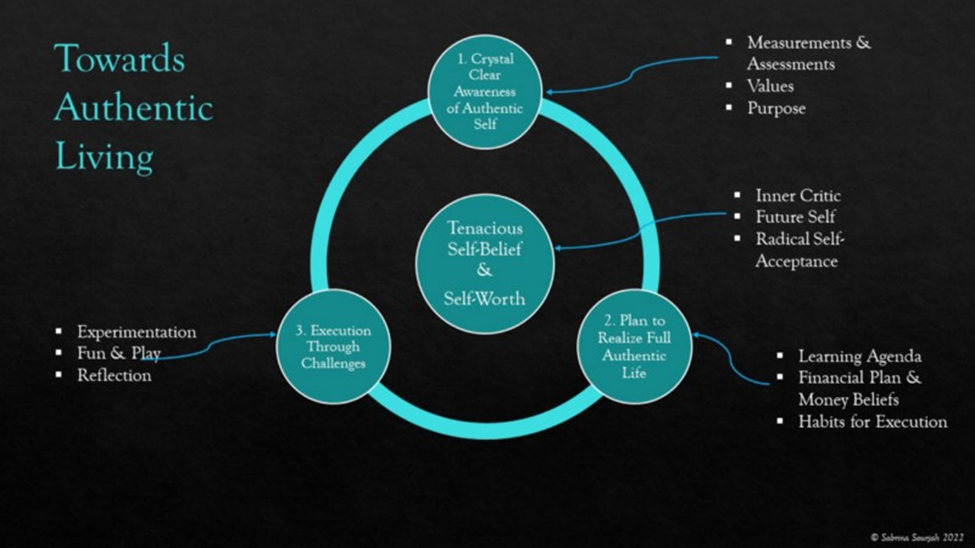
Authentic Living Model (Source: Author’s Workshop)
Finally, you need to implement this plan amid challenges and use the feedback from real life to tweak the plan. It’s crucial to bring an experimental mindset to this step and not forget to have fun along the way.
To be able to make progress along this authentic living process, you need two essential ingredients: self-trust and self-worth. These will enable you to face challenges with comfort and perspective.
So, this is all to say that changing into authentic living is hard. But after you’ve made the initial change, maintaining your authenticity is much easier because you will see how much less friction you have in your life. You can make decisions that work best for you and easily prioritize projects and people as well.
In other words, you will have it no other way.
Why authenticity is important
We are all on an authentic journey; we are at different stages of this journey. The sooner we accept that, the quicker we can access our most authentic selves, let go of these authenticity myths, and live a life of true alignment.
Let your authenticity guide you!
Follow me on Instagram, LinkedIn, and visit my website for more info!
Sabrina Sourjah, Executive Contributor Brainz Magazine
Sabrina Sourjah is a certified authenticity coach based in Toronto. She began coaching because of her unshakable belief that we all deserve better jobs, better relationships, and better lives. She gets a genuine high every time her clients progress towards their most authentic life by outdoing their former selves. In her past life, she has worked in various corporate and technology roles. She was mostly stressed at work, no matter how well things were going. Now, Mondays are Fridays for her. This is why she’s on a mission to get you to your most authentic life. Because she knows how wonderful life can be on the other side. When she's free, she loves to read, sing karaoke, go on long walks, and watch the sunset.







