What the New 35-Palette Color Analysis System Actually Changes
Kirsten Welsch is a certified 23-season color analyst and founder of ATX Color Studio near Austin, Texas. She also runs Business of Color Analysis, where she helps new color analysts build and market their businesses with confidence.

If you have been following the color analysis industry recently, you may have seen conversations about the new 35-Palette Color Analysis System. Some people are excited about the additional options, while others are wondering whether we really need more palettes at all.
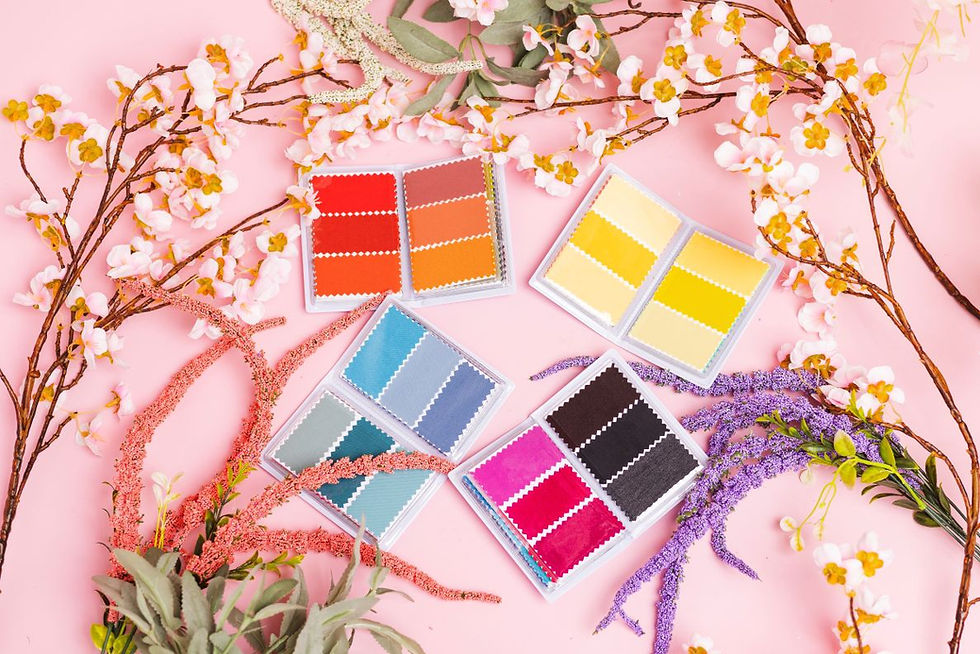
After completing the International Image Institute’s Advanced Color Analysis training in Toronto in September 2026, I became one of the first seven analysts trained in the expanded system. What I think is most important for clients to understand is that these additional palettes are designed to create more personalization, not to replace the seasonal system people already know.
What is the 35-Palette system?
Most people are familiar with the traditional four seasons: Spring, Summer, Autumn, and Winter. Over time, professional color analysis systems have become more detailed because natural coloring is much more nuanced than simply being warm or cool.
When I conduct a professional color analysis, I evaluate undertone, value, intensity, and contrast. Undertone refers to the underlying temperature of someone’s coloring. Value describes how light or deep the coloring is, while intensity, also called chroma, refers to how bright or muted it appears. Contrast looks at the differences in depth between a person’s natural features.
The International Image Institute’s established 23-Palette Color Analysis System already allows analysts to explore those differences in much greater detail than the original four-season approach. The new 35-Palette System builds on that framework by adding 12 dimensional palettes for clients whose coloring is particularly enhanced by a specific characteristic within their existing season.
Are there now 35 color seasons?
No. This is probably the biggest misconception I have seen online.
The 12 additions are new palettes, not 12 entirely new color seasons. The foundational seasonal categories are still Spring, Summer, Autumn, and Winter. The dimensional palettes allow for additional refinement within the existing system.
I can use myself as an example. I have known for quite some time that I am a True Spring. During my advanced training, however, I learned that I align more specifically with Spring High Value, which means I am especially flattered by the lighter colors within the True Spring palette. My season did not change. My undertone didn’t change, and my original analysis wasn’t suddenly wrong. I simply gained a more precise understanding of which colors within my existing season are especially harmonious with me.
Who can qualify for a dimensional palette?
Not everyone will qualify for one of the 12 additional palettes, and that is intentional.
Within the International Image Institute’s framework, the eight dimensional palettes associated with the True Home Seasons are designed for people with fully warm or fully cool undertones. The four Universal dimensional palettes are designed for people whose coloring is classified as fully neutral.
This distinction matters because many people fall into seasonal categories with blended undertones, such as neutral-warm or neutral-cool. For example, someone who is neutral-warm would not move into a dimensional palette simply because they happen to be very light, bright, or deep.
The 12 additional palettes are Winter Low Value, Winter High Contrast, Spring High Value, Spring High Chroma, Summer High Value, Summer Low Value, Autumn High Chroma, Autumn Low Chroma, Deep Universal, Light Universal, Bright Universal, and Muted Universal.
Even if someone meets the undertone criteria, that doesn’t automatically mean one of the dimensional palettes is a better fit. A True Spring may still be best represented by the original True Spring palette rather than Spring High Value or Spring High Chroma. The goal is greater precision when it helps, not reclassifying everyone into something new.
Does your previous color analysis change?
If you have already invested in a professional color analysis and love your existing palette, there is no reason to assume your result is now outdated.
The expanded system does not mean the previous 23-Palette framework was incorrect. Instead, it gives trained analysts another layer of information when a client’s coloring clearly benefits from additional refinement.
That distinction is important to me. Color analysis should leave clients feeling more confident, not make them wonder whether they constantly need a new answer every time a methodology evolves.
The same is true when using your palette in everyday life. I have written before about why black isn’t universally flattering and five neutrals that work better. Your palette should give you useful direction, but it should never eliminate your personal style or make you feel restricted.
Why more personalization matters
One reason I find the expanded system so interesting is that two people can share the same season without being equally flattered by every color in that palette.
When you work with clients regularly, you begin to see how much variation exists even within the same seasonal category. Lighter colors may especially enhance one True Spring, while another may look strongest in the clearest, most saturated parts of the palette.
That does not mean the broader season is wrong. It means it can have additional nuance.
To me, that is the most valuable part of the 35-Palette System. More palettes aren’t useful just because there are more of them. They are useful when they help an analyst provide a client with more specific, practical recommendations.
What this means for clients
As a client, you do not need to memorize 35 palettes or understand every technical distinction. That is the analyst’s job.
The goal of a professional color analysis is still the same: to identify the colors that harmonize with your natural coloring so you can make more confident decisions about clothing, makeup, hair color, and accessories.
Whether your result falls within one of the original 23 palettes or one of the 12 additional dimensional palettes, you should walk away understanding your colors more clearly, not feeling more confused.
Discover your best colors
If you are curious about your own color season, I offer professional 23-Season and 35-Palette color analysis through ATX Color Studio in Bee Cave, Texas, just outside Austin, as well as virtual color analysis for clients worldwide.
The expanded system gives us another way to personalize color recommendations, but the goal remains simple: helping you understand which colors make you look and feel your best.
Read more from Kirsten Welsch
Kirsten Welsch, Founder & Master-Trained Color Analyst
Kirsten Welsch is a certified 23-season color analyst and the founder of ATX Color Studio in Bee Cave, Texas. After years of designing luxury weddings in Costa Rica, she discovered color analysis and realized the power of wearing the right colors firsthand. That experience inspired her to help other women feel that same confidence. She now offers in-person and virtual color analysis sessions and runs Business of Color Analysis, where she mentors aspiring color analysts on marketing, social media, and building a successful business. Her mission is helping women stop guessing and start glowing.