Why Every Child Needs Time, Safety, and Motivation to Thrive
Written by Helen Kenworthy, Artistic Director
Helen champions the arts as a tool for change. Now, as CEO of RYTC Creatives Community Interest Company (CIC) and Give Get Go Education, she mentors young people, creates pathways for them to thrive in the arts, and helps launch successful careers.

Most school systems are built around a single, unspoken assumption: that a class of children of the same age should be ready to learn the same thing, in the same way, at the same moment. It is an efficient assumption and an easy one to timetable around. It is also, for a great many children, simply untrue.
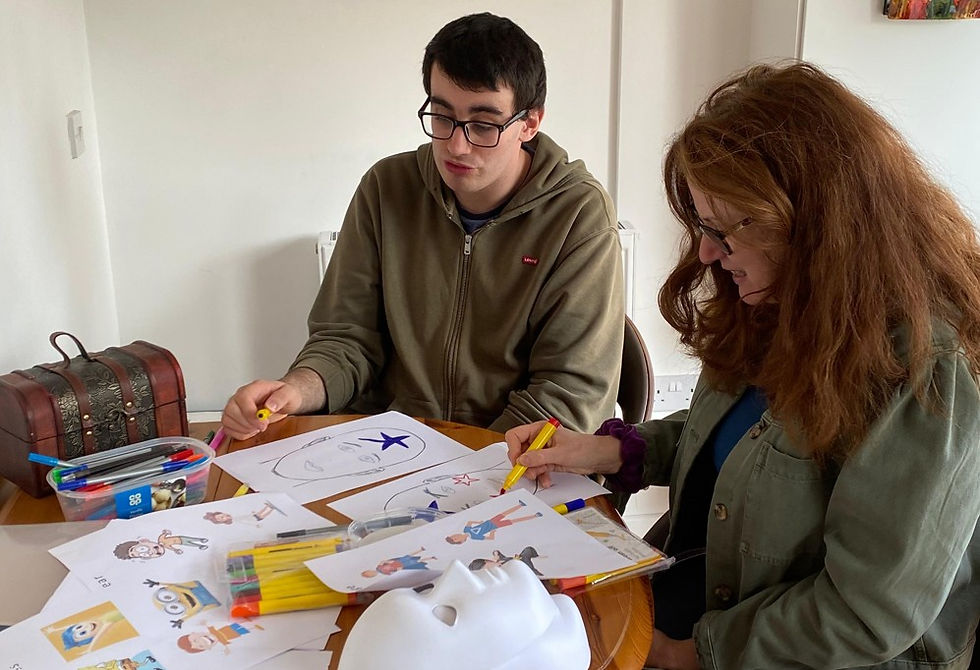
Helen Kenworthy's work through Of Course You Can!™, serving the brilliantly underestimated, challenges this assumption directly. A system designed for exam factory efficiency, moving large numbers of children through a fixed curriculum at a fixed pace, was never built to notice that one child needs longer to feel safe before they can learn, another needs a different kind of motivation to engage at all, and a third simply moves through ideas at their own, entirely valid speed.
None of this is a flaw in the child. A car does not fail because it was never built to fly. A one-speed system fails a child who was never built to move at that particular speed, and the failure belongs to the mismatch, not to the child caught inside it.
Many parents and educators already sense this gap long before they have language for it. They notice a child who understands a concept perfectly well at home, yet freezes the moment it is tested under pressure. They notice a bright, capable young person who has simply stopped trying, not because they cannot succeed, but because the pace on offer never gave them a real chance to.
This article looks at why speed became the default measure of success, what it means to challenge that measure honestly, and eleven practical ways that shift changes what becomes possible for a child who has never quite fitted the pace they were given.
Why speed became the default measure of progress
The idea that faster progress means better progress did not emerge from an understanding of how children actually learn. It emerged from the practical demands of educating very large numbers of children within limited time, funding, and staffing, using a curriculum that had to be delivered on a fixed schedule regardless of who was in the room.
Within that structure, pace became the easiest thing to measure and therefore the easiest thing to reward. A child who kept up was labelled capable. A child who did not was labelled behind, struggling, or in need of intervention, regardless of whether the real issue was ability, readiness, safety, or a simple mismatch between the child and the method being used to teach them.
Over time, this created a powerful but misleading shorthand in which speed became a stand-in for intelligence and worth. Children who process information differently, who need more time to feel emotionally safe before they can concentrate, or who are motivated by something other than grades and deadlines were left with a system that had no real place for them, only a queue for falling behind it.
What challenging the one-speed myth actually looks like
Challenging the one-speed myth does not mean abandoning structure, lowering expectations, or suggesting that pace never matters. It means recognising that time, safety, and motivation are not optional extras layered on top of learning. They are the conditions that make learning possible in the first place, and they look different for every child.
In practice, this might mean allowing a child longer to settle into a new topic before assessing them on it, or recognising that a child who appears distracted is often a child who does not yet feel safe enough to focus. It might mean discovering that a child who resists a worksheet will engage fully with the same idea explored through a creative project, a conversation, or a hands-on task.
None of this requires abandoning high expectations. It requires separating the expectation that a child will eventually understand something from the assumption that they must understand it within an arbitrary, fixed window of time.
Signs a child is being pushed beyond their own pace
Children rarely announce that a pace is wrong for them in so many words. More often, the signal appears through behaviour. Parents and educators may notice patterns such as:
Understanding an idea clearly in conversation, yet failing to demonstrate it under timed conditions.
A sudden drop in effort on tasks the child was previously willing to attempt.
Physical signs of stress before lessons, tests, or homework, such as stomach aches or reluctance to leave the house.
Rushing through work carelessly simply to be finished, rather than to do it well.
Becoming disproportionately upset by mistakes that would not previously have troubled them.
Disengaging entirely from a subject they once showed genuine interest in.
Comparing themselves unfavourably and repeatedly with classmates based on how quickly they finish work.
These signs are rarely about laziness or unwillingness. Far more often, they describe a child whose safety, motivation, or readiness has not been given the room a fixed pace assumes every child already has.
The adult's role in protecting a child's own pace
Within Helen Kenworthy's approach, the adult's role shifts from enforcing a fixed schedule to protecting the conditions a child actually needs in order to learn well. This does not mean removing all deadlines or structure, both of which many children continue to need and even welcome.
It means noticing when a deadline is serving the child's learning and when it is simply serving the convenience of the timetable. An adult who protects a child's own pace will ask why a task feels rushed before assuming the child is simply behind, and will look for the version of a task that lets a child show genuine understanding rather than only speed.
This is not always comfortable, particularly within a system that still measures success by how quickly a cohort moves through a curriculum. It means sometimes slowing down when every external pressure suggests speeding up, and trusting that a child who is finally given the right pace will often close the very gap that pace pressure had widened.
What genuinely supporting a child's own pace involves
Time: allowing a concept to be revisited and consolidated rather than moved past on schedule.
Safety: creating an environment where a child does not fear getting something wrong in front of others.
Motivation: connecting a task to something the child genuinely cares about, rather than only to a deadline.
Flexibility: offering more than one route to demonstrate the same understanding.
Consistency: maintaining the same level of patience on a hard day as on an easy one.
Trust: believing a child's own account of what they find difficult, rather than only external measures of it.
Together, these conditions turn pace from a source of pressure into something that can actually be adjusted to fit the child in front of you, rather than the other way around.
Why this matters for the brilliantly underestimated
Children who are brilliantly underestimated are especially likely to be harmed by a one-speed system, not because they lack ability, but because their particular combination of pace, safety needs, and motivation rarely matches what a fixed schedule assumes.
A child who needs more time to feel safe before engaging is not behind. A child who is motivated by meaning rather than marks is not unmotivated. Yet within a system built for exam factory efficiency, both are at real risk of being quietly written off before anyone has properly understood what they actually need.
Recognising the one-speed myth for what it is protects these children from a particular kind of harm: being judged by a measure that was never built with them in mind, and concluding, long before it is true, that they simply are not capable.
Turning this into action through the Creative Pathway Methodology
This is where the philosophy behind The RYTC, Education Selection Box, and the guidance in When School Doesn't Fit becomes especially useful. All three reject the idea that a single pace can ever fairly measure every child, and all three are built around giving time, safety, and motivation the same weight as academic content.
Education Selection Box works from the understanding that a child who is given the right pace, rather than a faster one, is far more likely to genuinely master a subject rather than simply survive it. Its approach makes room for a child to revisit, slow down, and build confidence before being expected to demonstrate speed, treating consolidation as progress rather than delay.
The RYTC, through its work in creative arts, offers children an entirely different route into confidence and motivation, one where safety and self-expression are built into the process itself, rather than being conditions a child must already possess before they are allowed to take part.
When School Doesn't Fit gives parents and practitioners a clear framework for recognising when a child's difficulty is really a pace mismatch rather than a lack of ability, and for making the case, calmly and with evidence, for the time and flexibility that child genuinely needs.
11 ways challenging the one-speed myth helps children thrive
Letting go of a single fixed pace does not happen through one policy change. It happens through repeated, deliberate choices to notice what a child actually needs rather than assume they need what the timetable provides. The following eleven outcomes show what becomes possible once that shift takes hold.
It separates understanding from speed: A child can be judged on whether they genuinely grasp an idea rather than on how quickly they produced it. This alone changes what success looks like for children who think carefully rather than instantly.
It reduces anxiety around assessment: When time pressure is no longer the main obstacle, a child's real understanding becomes far easier to see. Anxiety that once masked ability begins to lift.
It restores motivation that pace pressure had worn away: A child who has stopped trying under one pace often re-engages fully once given a pace that fits them. Motivation returns when effort finally has a realistic chance of succeeding.
It creates space for safety to develop before performance is expected: Children who feel safe take more risks, ask more questions, and recover faster from mistakes. Safety is not a delay to learning. It is what makes deeper learning possible.
It allows different forms of intelligence to be seen: A child who struggles with speed may excel in depth, creativity, or practical problem solving. Removing the one-speed measure lets these strengths become visible rather than hidden behind a low mark.
It prevents early setbacks from becoming permanent labels: A child who is simply not ready yet is very different from a child who cannot. Protecting pace keeps the door open for a child to catch up later without carrying an early label forward unfairly.
It improves the relationship between child and adult: When an adult stops treating pace as fixed, a child stops experiencing it as an obstacle to get past. The relationship shifts from pressure and resistance towards genuine partnership.
It teaches children to value understanding over completion: Children learn what is rewarded. When depth is rewarded over speed, they begin to take genuine pride in understanding something well rather than simply finishing first.
It reduces behaviour that comes from feeling constantly behind: Much disengagement and disruption stem from the exhaustion of never quite keeping up. Removing that constant pressure often removes the behaviour that grew out of it.
It makes room for motivation that is personal rather than imposed: A child who is motivated by curiosity, creativity, or purpose responds very differently to a task shaped around that motivation. This kind of engagement rarely appears under pressure alone.
It gives a child permission to succeed on their own terms: Over time, a child who is no longer measured against an artificial pace begins to trust their own way of learning. That trust often outlasts the specific subject or school year it began with.
Taken together, these eleven outcomes are not about lowering the bar for any child. They are about recognising that the bar was only ever fair when the pace, safety, and motivation required to reach it were fair too.
Why slowing down can speed up real progress
It can feel counterintuitive to suggest that slowing down leads to faster progress, particularly within a system built to measure speed above almost everything else. Yet children who are given the right pace at the outset frequently move through subsequent material more quickly because the foundation beneath them is genuinely secure rather than only superficially covered.
A child who is rushed through a concept before they are ready often needs to return to it repeatedly, each time with growing frustration and shrinking confidence. A child who is given the time to understand it properly the first time rarely needs to revisit it at all. What looks like delay in the short term is very often the fastest route to lasting progress.
Conclusion
A child who moves at a different pace is not a child who is falling behind. They are a child whose time, safety, and motivation have not yet been given the attention a fixed system was never designed to offer.
Helen Kenworthy's work through Of Course You Can!™ treats pace as something to be understood and protected, not something every child must simply keep up with regardless of what it costs them. For the brilliantly underestimated, challenging the one-speed myth can be the difference between a child who is quietly written off and one who is finally given the conditions to show what they can do.
Every child can thrive. Very few of them thrive at exactly the same speed, and building an education around that simple truth changes everything that follows.
To explore more about this work and the wider Creative Pathway approach, please visit here.
Creative Pathway Methodology: Of Course You Can! Serving the Brilliantly Underestimated.
Read more from Helen Kenworthy
Helen Kenworthy, Artistic Director
Helen Kenworthy’s career embodies the transformative power of the arts, from her early roles in the prestigious West End with Bill Kenwright to her impactful work in regional theatre. As manager of the Oxfordshire Youth Arts Partnership, she created pathways for young people to thrive in the arts, with many going on to successful careers. Now at RYTC Creatives CIC and Give Get Go Education, Helen continues to inspire and mentor the next generation of theatre-makers and community leaders, offering invaluable opportunities for growth and professional development.