A Simple Way To Get Your Business Priorities In Line
Written by: Kyle Gillette, Executive Contributor
Executive Contributors at Brainz Magazine are handpicked and invited to contribute because of their knowledge and valuable insight within their area of expertise.

I believe all great leaders are SAGE Leaders.
In my research studying, experiencing, and being led by great leaders, I’ve found they all have four core mindsets that make them great.

These mindsets are
Self-Awareness
Accountability
Growth
Empowerment
I like to describe how a SAGE leads using the metaphor of a house. The foundation of their leadership is self-awareness. The more self-aware these leaders are, the stronger their leadership foundation.
The walls and roof of their leadership house represent the growth mindset. The more a leader believes in their ability to grow, the more actions they take toward this growth. In the leadership house, it is the walls and roof that represent the growth mindset.
Next, all SAGE Leaders empower those around them to do, be, and achieve more. In their leadership house, represented by the windows and doors. The windows and doors allow others to step in or out of a leader’s influence.
Finally, accountability serves as the nails that hold the leadership house together. No matter how strong the foundation or how much influence a leader has, the whole house will come tumbling down without accountability. SAGE Leaders know this and build uncommon accountability to combat this threat.
In short, SAGE Leaders consistently build self-awareness, have uncommon accountability, maintain a growth mindset, and empower others to do, be, and achieve more.
Within this leadership, houses are well-defined priorities. These priorities aren’t based on the whims of the day or the week but purposefully chosen to create results.
In the book “The 7 Habits of Highly Effective People,” Stephen R. Covey describes a simple matrix for priorities that these SAGE Leaders have learned or intuitively follow.
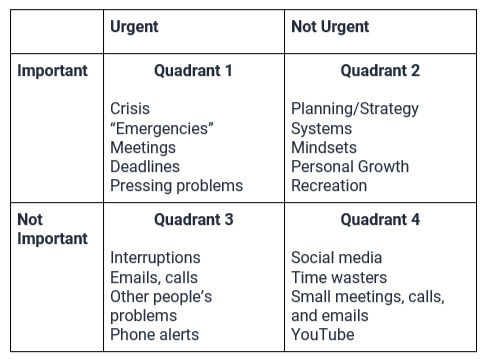
Unfortunately, for many business owners, we get caught up in the tyranny of the urgent. What's important gets shoved aside by the urgent and not important when we feel a bit overwhelmed. Sometimes we just want a break and fall into the trap of not important AND not urgent stuff and watch YouTube, or is that just me?
According to Covey, quadrant two is where business owners and leaders need to spend most of their time. Unfortunately, most people spend their time in quadrant one. Whatever is seemingly important and urgent becomes the default priority for too many business owners. Poor time management, unclear goals, and not sticking with your word is the result.
This model helps us understand our priorities, but I want to go a layer deeper and help you determine what yours are and what might be out of balance. Let me illustrate with a story.
Rocks, Pebbles, & Sand
A philosophy professor once got up in front of his class with an enormous empty glass jar. He filled the jar to the brim with large stones and asked if it was full.
The students all agreed the jar was full.
To ensure the pebbles dispersed, he gently shook the jar. He then asked, "Is the container now full?"
The students agreed again the jar was full.
The professor then poured sand into the jar to fill up the remaining space.
The students now saw that it was actually full.
The jar represents your life's and business's priorities, while the pebbles, sand, and rocks represent the significance of those priorities. The rocks represent the most important projects and things you have going on, such as growing your business, leading well, spending time with your family, and maintaining proper health.
The pebbles represent the lower priority things in your life that matter but that aren't essential. The pebbles are certain things that give your life meaning (such as your job, house, hobbies, and friendships), but they are not critical for you to have a meaningful life. These things often come and go and are not permanent or essential to your overall well-being.
Finally, the sand represents the remaining filler things in your life and material possessions, such as watching television, browsing your favorite social media site, or running errands. These things don't bring meaning to your life, but they are usually the tasks that fill our work and lives the most.
The metaphor shows that the jar would still be full. Your life would still have meaning with the loss of pebbles and the sand.
If you've ever been to the beach and then come home, you know that sand can get everywhere. We have to be careful that this sand doesn't wreck things and distracts us from the big rocks that are most important to our business.
Understanding Your Priorities
Get out a piece of paper and write down 5-7 areas of business that you are focused on right now. Leave enough space for two columns next to these categories so you can do some ranking.
Once you have your 5-7 categories, I want you to think about how much time you spend on each. Now in the first column next to the list, write at the top “Reality.” Here, rank the list from 1-7 in order of how much actual time you spend on each during a given week.
Next to the “Reality” column, create a new column that says “Ideal.” I want you to rank your list based on the ideal amount of time you would spend on each category in this column.
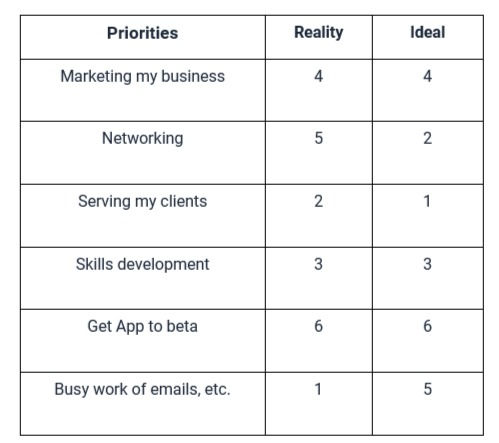
If you are like most small business owners, your reality and ideal columns won’t match. Some need to flip the list to give the “rocks” the right amount of time and focus.
While I recognize that some categories take longer than others, getting these priorities out of your head and on to paper will help you make some simple adjustments to get things back on track.
The “gold” is seeing the difference between ideal and reality then choosing to make a few simple adjustments to get closer to your ideal. As business owners, that is a big win! Do this monthly, and your priorities will stay where you want them to be most of the time.
In Conclusion
Our priorities will get mixed up and confused from time to time. This is normal in the course of running a business. The problem is when we don’t take the time to look at the jar and see how much sand and pebbles are filling up our day. My suggestion is to add this priority exercise to your calendar and complete it once a month.
When our priorities are out before us, we can perform at a much higher level as leaders. Additionally, having your priorities clarified and allocated correctly will help your team and business function better.
This may be a simple exercise, but there’s an insight gained every time I do it or have clients do it.
Kyle Gillette, Executive Contributor Brainz Magazine
Kyle Gillette is an expert mindset coach. After working for 9 years in a men's mentoring program and seeing how much the student's mindsets were limiting their success, Kyle created the SAGE Mindset® Framework. He now helps small business owners who are struggling with burnout, feeling overwhelmed with work, or just plain stuck create the habits and mindsets gain the clarity, confidence, and clients they deserve. Kyle is also the creator of the SAGE Mindset App, he's an author, and host of the SAGE Mindset Podcast. He's been coaching and leading people in the non-profit and small business contexts for 20 years. Kyle desires to help his clients become the leaders they were meant to be.