Are the Old Gods Returning? Why Ancient Archetypes Are Resonating in Modern Life
Dani Van de Velde is a passionate advocate for living a spiritually aligned life in the modern world. She is a meditation teacher, Reiki Master, psychic medium, and author of Spirited. She is the founder of Spirited Living and Spirited Business online communities, a broadcaster on News for the Soul Radio, and host of The Modern Crone podcast.

Modern spirituality is changing. Whilst the world's great religious traditions remain enormously significant and continue to shape the spiritual lives of billions of people, ancient gods and goddesses are appearing in books, podcasts, and social media feeds. Tarot cards are shuffled across café tables. Astrology has moved onto our phones. Ritual, pilgrimage, ancestral practices, and nature-based spirituality are finding new audiences. It’s got me asking: what are human beings seeking from spirituality now?
A changing spiritual landscape
It would be easy to interpret the current fascination with alternative spirituality as evidence that traditional religion is disappearing. However, the statistics tell a much more nuanced story.
Pew Research Centre's most recent comprehensive analysis of the global religious landscape, published in 2025, estimates that about three-quarters of the world's population identifies with a religion. Christianity remains the world's largest religious group, with approximately 2.3 billion adherents, followed by Islam with around 2 billion and Hinduism with 1.2 billion.
Islam was the fastest-growing major religious group between 2010 and 2020. Hinduism grew broadly in line with global population growth, while Christianity grew in absolute terms but declined slightly as a share of the world's population.
Traditional religious life is very much alive, but something else is happening alongside it. The religiously unaffiliated population has also grown, reaching approximately 1.9 billion people in Pew's global analysis. Newer research suggests that not adhering to a specific religion does not necessarily mean a lack of spiritual interest.
The Pew study focused specifically on religiously unaffiliated adults across 22 countries. In every country surveyed, at least one in five believed in an afterlife. In seven countries, half or more did. Significant numbers also believed that something spiritual exists beyond the natural world or that animals and parts of nature can possess spirits or spiritual energies.
An even broader 2025 study across 35 countries found belief in life after death, spiritual forces, ancestral influence, and the spiritual dimensions of nature across cultures and religious identities.
Are we witnessing something more interesting than a simple movement away from religion and towards spirituality?
We may be seeing an increasingly plural spiritual landscape: inherited faith alongside personal practice, institutional religion alongside individual exploration, and ancient traditions finding new expressions in modern life. I find this extremely interesting and exciting!
The ancient questions remain
Whatever language we use to speak of the sacred, the fundamental questions of being human remain: Who am I? Why am I here? How do I navigate suffering? How do I know which path to take? What happens when I die? How do I live well? Is there something greater than me? If so, how do I enter into a relationship with it?
The world's religions have contemplated these questions for millennia, as have philosophers, mystics, and contemplatives. Increasingly, science is entering some of these conversations.
When neuroscience meets spirituality
This intersection has fascinated me for many years: the meeting point of psychology, neuroscience, contemplative practice, and modern spirituality, and what each discipline might illuminate about the others.
Neuroscience is now examining experiences and practices once discussed predominantly within religious, mystical, or spiritual contexts. Researchers are investigating meditation and prayer, altered and mystical states, near-death experiences, consciousness, and the neurological effects of long-term contemplative practice.
A major neuroscience review published in 2025, for example, examined the neural mechanisms underlying meditation, prayer, near-death experiences, psychedelic experiences, and other spiritual states, describing a rapidly expanding field of enquiry into religious and spiritual experience.
This does not mean neuroscience is proving or disproving spiritual claims. It means that experiences humans have described for thousands of years are increasingly regarded as worthy of serious scientific investigation.
I was reminded of this last month while listening to neuroscientist Dr Tara Swart speak at Oxford University. Her work, including her book The Source, brings neuroscience and behavioural psychology into conversation with practices such as visualisation, intention, and intuition, and explores possible mechanisms such as neuroplasticity, attention, and behaviour.
We are living in an intriguing time. At precisely the moment that ancient spiritual practices and archetypes are being rediscovered, we are developing new scientific languages to examine some very old human experiences. This brings us back to the gods.
Ancient gods, modern archetypes
We can approach an ancient deity in various ways. We can encounter them historically by learning about the cultures, stories, and practices from which they emerged.
We can encounter them spiritually, as people have for centuries and continue to do so today, through devotion, prayer, ritual, and relationship.
We can encounter them archetypally by exploring the recurring human experiences, psychological patterns, and symbols they embody. These approaches do not necessarily need to compete with each other.
The ancient pantheons are filled with figures associated with love, war, creativity, death, fertility, sovereignty, transformation, destruction, and rebirth. They give faces and stories to experiences that remain profoundly human. Then there is Hecate.
Why Hecate, and why now?
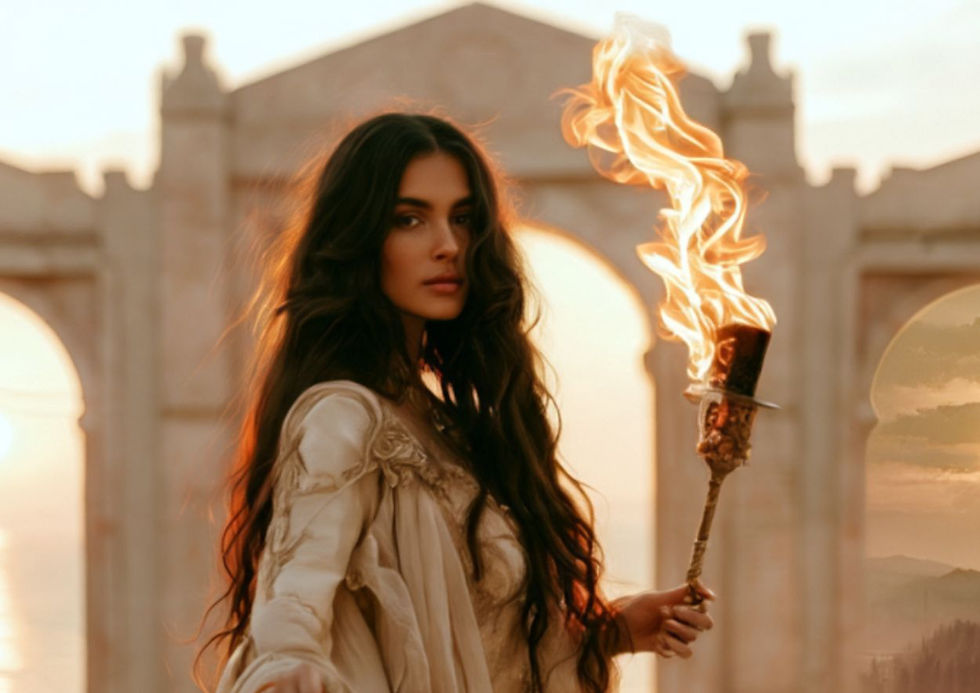
Hecate is an ancient goddess associated with thresholds, crossroads, torches, keys, liminal spaces, and the night. She is a complex deity whose history deserves respect. For ancient people, she was a goddess, and for contemporary devotees, she remains one.
Yet she also carries a remarkably potent archetypal resonance for modern life because we are living through an age of enormous change, an age of thresholds.
Artificial intelligence is transforming how we understand work, creativity, and even human cognition. Climate change is reshaping our relationship with the natural world. Traditional life stages are shifting. Our relationships with ageing, family, community, and identity continue to evolve. Many of us will change careers, countries, and relationships, and perhaps even entire versions of ourselves, several times in one lifetime.
We are perpetually at crossroads. What do I leave behind? What do I take with me? Which road is mine? What do I do when I cannot yet see what lies ahead? Suddenly, an ancient goddess carrying torches at the crossroads does not seem terribly ancient.
When archetype becomes relationship
This is where I believe working with archetypes is particularly potent. We can read about Hecate. We can study her history, epithets, and mythology. We can intellectually understand that keys, torches, and crossroads are associated with her.
But something changes as we begin to work with those symbols over time. A key becomes a question: What am I ready to unlock? A crossroads asks: Where am I hesitating? A threshold asks: What am I ready to step into? A torch asks: What can I see now that I could not see before?
The symbol begins to interact with our lived experience, and this is where archetype becomes relationship.
The ancient gods were never merely intellectual concepts to the people who lived alongside them. They were invoked, honoured, questioned, and celebrated. People made offerings, took part in processions, built shrines and temples, told their stories, and sought their guidance.
They were encountered. Ritual gives us a way to explore this today. We light the candle. Turn the key. Walk the path. Make an offering. Sit in contemplation. Repeat a mantra.
The experience moves beyond cognition into the body, imagination, emotion, attention, and environment. Through sustained attention, symbols can begin to take on deeply personal meaning.
Why 90 days?
This is the enquiry at the heart of my new course, 90 Days with Hecate. I am interested in what happens when we stay with an archetype long enough for a relationship to form.
Starting in November, over 90 days, we will explore Hecate through her mythology and epithets, meditation, lunar cycles, ritual, journaling, and simple magical practices. We will work with thresholds, keys, boundaries, and pathways, observing what these ancient symbols illuminate in contemporary lives.
You do not need to arrive with a fixed theological position on who or what Hecate is. You might understand her as a goddess, an archetype, an aspect of the psyche, spiritual intelligence, or a symbolic framework. You might simply arrive curious.
The more interesting question is: What happens when I enter into a relationship with her?
What begins to shift when I contemplate the same archetypal territory over weeks rather than minutes? What do I notice? What patterns become visible? What doors am I ready to close? Which one am I ready to open? Which road am I finally prepared to walk?
Are the old gods returning?
Human beings are rediscovering very old languages for experiences that never disappeared. We still stand at crossroads. We still grieve, love, fear, create, and transform. We still search for meaning when the road ahead vanishes into darkness.
Whether that search takes place within a church, mosque, temple, synagogue, sacred landscape, meditation room, or at a candlelit altar, the impulse itself is profoundly human.
We continue to reach towards meaning, mystery, and a relationship with something larger than ourselves.
Read more from Danielle Van de Velde
Danielle Van de Velde, Meditation Teacher, Reiki Master, Psychic Medium & Author
Dani Van de Velde is a meditation teacher, Reiki Master, psychic medium, and author of Spirited. She is the founder of the Spirited Living and Spirited Business communities, supporting spiritually aligned growth and conscious leadership. Dani is a broadcaster on News for the Soul Radio and host of The Modern Crone podcast, exploring modern spirituality and embodied wisdom. Her work bridges intuition and everyday life, offering grounded, accessible pathways to self-trust and inner clarity. She is known for a warm, practical approach that honours both the mystical and the real.
References:
Pew Research Center (2025), How the Global Religious Landscape Changed From 2010 to 2020: Comprehensive demographic analysis drawing on more than 2,700 censuses, surveys, and population registers. Source for global religious population estimates and trends.
Pew Research Center (2025), Believing in Spirits and Life After Death Is Common Around the World: International research covering 35 countries, examining belief in an afterlife, spiritual realities, spirits or energies in nature, ancestral influence, reincarnation, magic, and spiritual practices.
Pew Research Center (2025), Many Religious "Nones" Around the World Hold Spiritual Beliefs: Analysis of religiously unaffiliated adults across 22 countries, based primarily on nationally representative surveys conducted in 2023 and 2024.
Pew Research Center (2025), Spells, Curses and Ways to See the Future: International data on belief in magic and the use of fortune tellers, horoscopes, and other practices intended to see the future.
Jedlicka, P. & Havenith, M.N. (2025), Religious and Spiritual Experiences From a Neuroscientific and Complex Systems Perspective, Neuroscience & Biobehavioral Reviews, 177: A contemporary review of neuroscience research into meditation, prayer, near-death experiences, psychedelic experiences, and other religious and spiritual states.
Swart, T., The Source: An accessible exploration of neuroscience and behavioural psychology in relation to intention, visualisation, neuroplasticity, and personal change.